" width="31.844343999969944px"><path d="M 0 31.84 L 0 0 L 31.84 0 L 31.84 31.84 Z" fill="transparent" height="31.8403px" id="bDMh1GdUQ" transform="translate(0.002 0)" width="31.8403px"/><path d="M 0 0 L 0 31.84 L 14.379 31.84 L 14.379 19.139 L 8.175 25.342 L 5.995 23.162 L 15.922 13.235 L 25.849 23.162 L 23.669 25.342 L 17.466 19.139 L 17.466 31.84 L 31.844 31.84 L 31.844 0 Z M 23.667 16.772 L 15.92 9.025 L 8.173 16.772 L 5.993 14.592 L 15.92 4.664 L 25.847 14.592 Z" fill="rgb(63, 91, 30)" height="31.84030625px" id="LkBC_qYlr" transform="translate(0 0.002)" width="31.844344px"/></g><path d="M 4.708 16.728 L 4.708 2.772 L 0 2.772 L 0 0 L 12.666 0 L 12.666 2.772 L 7.958 2.772 L 7.958 16.728 Z" fill="rgb(38, 45, 30)" height="16.72833px" id="gGM6jCh9B" transform="translate(117.426 7.593)" width="12.666000000000011px"/><path d="M 6.978 17.111 C 5.815 17.111 4.756 16.912 3.8 16.513 C 2.844 16.099 2.031 15.502 1.362 14.721 C 0.709 13.94 0.255 13 0 11.901 L 2.939 11.041 C 3.178 12.076 3.664 12.889 4.397 13.478 C 5.13 14.052 5.99 14.339 6.978 14.339 C 7.743 14.339 8.396 14.163 8.938 13.813 C 9.479 13.462 9.75 12.913 9.75 12.164 C 9.75 11.686 9.583 11.304 9.248 11.017 C 8.93 10.714 8.508 10.467 7.982 10.276 C 7.456 10.085 6.875 9.902 6.237 9.726 C 5.6 9.551 4.963 9.352 4.325 9.129 C 3.688 8.906 3.107 8.619 2.581 8.269 C 2.055 7.902 1.625 7.44 1.29 6.883 C 0.972 6.309 0.813 5.592 0.813 4.732 C 0.813 3.776 1.075 2.947 1.601 2.246 C 2.127 1.529 2.828 0.98 3.704 0.597 C 4.58 0.199 5.544 0 6.596 0 C 7.631 0 8.579 0.175 9.44 0.526 C 10.316 0.876 11.049 1.37 11.638 2.007 C 12.244 2.629 12.658 3.37 12.881 4.23 L 10.013 5.353 C 9.774 4.509 9.352 3.871 8.747 3.441 C 8.141 2.995 7.416 2.772 6.572 2.772 C 5.807 2.772 5.194 2.939 4.732 3.274 C 4.286 3.593 4.063 4.031 4.063 4.588 C 4.063 5.019 4.222 5.369 4.541 5.64 C 4.875 5.895 5.305 6.11 5.831 6.285 C 6.357 6.444 6.938 6.604 7.576 6.763 C 8.213 6.906 8.85 7.098 9.487 7.337 C 10.125 7.56 10.706 7.854 11.232 8.221 C 11.758 8.587 12.18 9.073 12.498 9.679 C 12.833 10.284 13 11.041 13 11.949 C 13 13.048 12.729 13.988 12.188 14.769 C 11.662 15.533 10.945 16.115 10.037 16.513 C 9.129 16.912 8.109 17.111 6.978 17.111 Z" fill="rgb(38, 45, 30)" height="17.11076px" id="W33rhMq3Y" transform="translate(102.662 7.402)" width="13px"/><path d="M 0 16.728 L 0 0 L 11.328 0 L 11.328 2.772 L 3.274 2.772 L 3.274 6.644 L 9.798 6.644 L 9.798 9.416 L 3.274 9.416 L 3.274 13.956 L 11.423 13.956 L 11.423 16.728 Z" fill="rgb(38, 45, 30)" height="16.72833px" id="LASbkhR29" transform="translate(89.162 7.593)" width="11.422699999999992px"/><path d="M 0 16.728 L 0 0 L 6.357 0 C 7.408 0 8.324 0.207 9.105 0.621 C 9.902 1.02 10.523 1.593 10.969 2.342 C 11.415 3.075 11.638 3.935 11.638 4.923 C 11.638 5.879 11.383 6.755 10.873 7.552 C 10.379 8.332 9.694 8.93 8.818 9.344 L 12.833 16.728 L 9.153 16.728 L 5.664 9.87 L 3.25 9.87 L 3.25 16.728 Z M 3.25 7.098 L 5.783 7.098 C 6.58 7.098 7.209 6.898 7.671 6.5 C 8.149 6.086 8.388 5.56 8.388 4.923 C 8.388 4.27 8.149 3.752 7.671 3.37 C 7.209 2.971 6.58 2.772 5.783 2.772 L 3.25 2.772 Z" fill="rgb(38, 45, 30)" height="16.72833px" id="DsldZOwJ8" transform="translate(73.861 7.593)" width="12.832999999999998px"/><path d="M 7.289 17.111 C 5.839 17.111 4.565 16.76 3.465 16.059 C 2.382 15.342 1.529 14.347 0.908 13.072 C 0.303 11.782 0 10.276 0 8.555 C 0 6.835 0.303 5.337 0.908 4.063 C 1.529 2.772 2.382 1.776 3.465 1.075 C 4.565 0.358 5.839 0 7.289 0 C 8.739 0 10.005 0.358 11.088 1.075 C 12.188 1.776 13.04 2.772 13.646 4.063 C 14.267 5.337 14.578 6.835 14.578 8.555 C 14.578 10.276 14.267 11.782 13.646 13.072 C 13.04 14.347 12.188 15.342 11.088 16.059 C 10.005 16.76 8.739 17.111 7.289 17.111 Z M 7.289 14.339 C 8.101 14.339 8.802 14.1 9.392 13.622 C 9.997 13.128 10.467 12.451 10.802 11.59 C 11.136 10.714 11.304 9.702 11.304 8.555 C 11.304 7.392 11.136 6.381 10.802 5.52 C 10.467 4.66 9.997 3.991 9.392 3.513 C 8.802 3.019 8.101 2.772 7.289 2.772 C 6.492 2.772 5.783 3.019 5.162 3.513 C 4.556 3.991 4.086 4.66 3.752 5.52 C 3.417 6.381 3.25 7.392 3.25 8.555 C 3.25 9.702 3.417 10.714 3.752 11.59 C 4.086 12.451 4.556 13.128 5.162 13.622 C 5.783 14.1 6.492 14.339 7.289 14.339 Z" fill="rgb(38, 45, 30)" height="17.11076px" id="ipX7BNsrY" transform="translate(56.609 7.402)" width="14.577600000000004px"/><path d="M 0 16.728 L 0 0 L 11.351 0 L 11.351 2.772 L 3.25 2.772 L 3.25 6.644 L 9.798 6.644 L 9.798 9.416 L 3.25 9.416 L 3.25 16.728 Z" fill="rgb(38, 45, 30)" height="16.72833px" id="T3zzexfqV" transform="translate(43.557 7.593)" width="11.351399999999998px"/></svg>)

Integration
MCP Server
Run a headless backoffice with Claude and Forest MCP Server
Guillaume Rigal
" transform="translate(1.749 1.749)" width="10.501px"/></g></svg>)
0 min read
How Forest exposes your backoffice as an MCP server, and how your team uses it with Claude. Managers open Claude Cowork and work through chat. AI agents your business team builds plug in and act. Same permission model, same approval gates, same audit trail.
Your Forest backoffice handles the standard flows. Onboarding queues, KYC reviews, risk tiering, dispute resolution. Your team knows those screens.
The trouble is everything else. The one-off question during a Monday standup. The edge-case customer whose data does not fit the standard filter. The exploratory chart nobody wants to build a dashboard for. The support case that needs three joins across records. Today someone opens Forest, clicks through filters, exports a CSV, or asks a dev to run a query.
Since Spring, Forest also exposes your backoffice as an MCP server. Managers open Claude Cowork and ask the question. AI agents your business team builds for customer service, edge cases, and one-off research plug into the same server. Reads or writes, everything runs under the caller's Forest permissions, with the approval gates and audit trail your compliance team already trusts.
The model reasons. Forest enforces the rules.
Team leads and managers use Claude to talk to the backoffice, and to build the custom AI agents that handle exploratory or edge-case work. Your regulated ops keep running in the Forest UI, under the rules your compliance team already signed off on. When Claude reaches into the backoffice, it goes through the Forest MCP server. Forest already knows who can read what, who can trigger what, and which actions need a human approval.
How Forest exposes your backoffice as an MCP server
Forest connects to your databases and SaaS tools as datasources, and exposes your operations as an MCP server. Any Claude client can connect to it: the Claude Cowork chat your managers use, and the AI agents your business team wires up. Same MCP server. Same permission model. Same audit trail.
Managers use Claude Cowork as the UI to a headless Forest
We've all gotten used to asking Claude questions and handing it tasks, basic or advanced. Now your managers can do the same with their Forest-accessible data. They open Claude Cowork, ask a question, get an answer from live production data. No Forest UI to open. No filters to click through.
Use cases we see:
Analysis. "MRR by industry over the last 12 months, animate the top 10."
Support triage. "Every case flagged in the last week with an amount above 10k."
Billing spot-checks. "This customer says they were charged twice on the 14th. What actually happened?"
Customer research. "Pull everything we know about this account before my call."
The manager does not need to know which collection to query or which Forest Action to trigger. Claude Cowork calls the Forest MCP server, lists the tools it exposes, picks the ones that fit the request, and runs them under the manager's Forest permissions. Nothing more, nothing less.
AI agents your business team builds, on Forest MCP
The AI agents in this architecture are not a dev project. Your business team builds them from Cowork with a plain-English description of what the agent should do. Claude turns that description into skills that call the Forest MCP server. No pipeline, no middleware, no API glue code.
Each AI agent runs under an already-scoped role in Forest, so it inherits exactly the permissions your compliance team has already signed off on. If a skill can trigger a Forest Action that requires approval, the approval gate still fires. Below the threshold, the AI agent acts. Above it, your team decides. The audit trail records the AI agent as the requester, with the run identifier so you can trace a chain of tool calls end to end.
At Forest, we run several kinds of AI agents on our own backoffice
Forest runs an internal instance of Forest, called Forest of Forest (FoF). Our own business team uses Claude Cowork against FoF every day, and we have built several types of AI agents on top of it. Support triage, billing spot-checks, customer research, and quick-research chart generation.
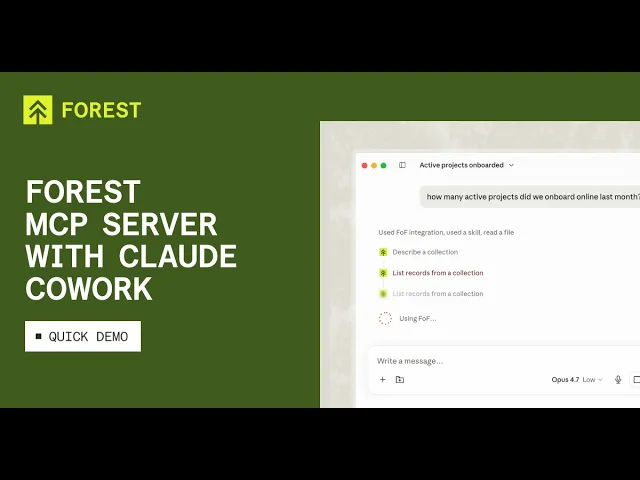
For this walkthrough, we focus on simple questions and a quick-research AI agent we call Gopher to get quick business answers.
Gopher takes a plain-English question, calls the Forest MCP server, picks the right collection, streams the shape back, and renders the answer. When you ask for a chart, it animates. Same permission model as any manager typing in Cowork. Same audit trail. No ETL, no dashboards to maintain.
This is not a sandbox. It is a production backoffice, called by Claude Cowork in real time.
What running Claude on Forest gives you
When your Claude Cowork sessions and the AI agents your team builds call Forest's MCP server, they work within a perimeter where Forest already enforces:
Permissions. The caller acts as a credentialed user or a credentialed service account. Role-based access control applies to every read and every write.
Audit trail. Every Claude-initiated action carries attribution to a real Forest identity, with the payload, the policy path, the approver, and the outcome.
Approval gates. actionApproval is part of Forest's data model. You attach it to any Action, with the conditions and authorized approvers you define.
Data residency. Forest's backend runs in your infrastructure. Your data does not travel to Forest's servers, nor to Anthropic's. It travels to a provider only at the step where its service is called, and the response is logged back to the case.
Forest is the AI-agent harness for fintech, payments, and regulated ops
Forest's MCP server works with Claude, Dust, and any AI-agent runtime that speaks MCP. You bring the client surface. Forest governs the execution.
The architecture is the same whether you are running KYC reviews, refund queues, dispute workflows, or account management at scale. Whether the caller is a manager in Claude Cowork or an AI agent your team built, the permissions, approvals, and audit trail come from the same place.
Get one of our FDEs to set up Claude and Forest for scale
Forest has a team of Forward Deployed Engineers ready to deploy this with your team. They design your AI-agent architecture, wire up the approval flows, and get you running at production scale on Forest's MCP server.
This is not just for onboarding. It is a high-touch hands-on program with engineers who know the stack. We are looking for teams with serious volume: high-frequency ops, multi-agent workflows, large transaction throughput, or regulated environments where the architecture has to be right.
If you are building agentic operations at that scale, talk to us now.