" width="31.844343999969944px"><path d="M 0 31.84 L 0 0 L 31.84 0 L 31.84 31.84 Z" fill="transparent" height="31.8403px" id="bDMh1GdUQ" transform="translate(0.002 0)" width="31.8403px"/><path d="M 0 0 L 0 31.84 L 14.379 31.84 L 14.379 19.139 L 8.175 25.342 L 5.995 23.162 L 15.922 13.235 L 25.849 23.162 L 23.669 25.342 L 17.466 19.139 L 17.466 31.84 L 31.844 31.84 L 31.844 0 Z M 23.667 16.772 L 15.92 9.025 L 8.173 16.772 L 5.993 14.592 L 15.92 4.664 L 25.847 14.592 Z" fill="rgb(63, 91, 30)" height="31.84030625px" id="LkBC_qYlr" transform="translate(0 0.002)" width="31.844344px"/></g><path d="M 4.708 16.728 L 4.708 2.772 L 0 2.772 L 0 0 L 12.666 0 L 12.666 2.772 L 7.958 2.772 L 7.958 16.728 Z" fill="rgb(38, 45, 30)" height="16.72833px" id="gGM6jCh9B" transform="translate(117.426 7.593)" width="12.666000000000011px"/><path d="M 6.978 17.111 C 5.815 17.111 4.756 16.912 3.8 16.513 C 2.844 16.099 2.031 15.502 1.362 14.721 C 0.709 13.94 0.255 13 0 11.901 L 2.939 11.041 C 3.178 12.076 3.664 12.889 4.397 13.478 C 5.13 14.052 5.99 14.339 6.978 14.339 C 7.743 14.339 8.396 14.163 8.938 13.813 C 9.479 13.462 9.75 12.913 9.75 12.164 C 9.75 11.686 9.583 11.304 9.248 11.017 C 8.93 10.714 8.508 10.467 7.982 10.276 C 7.456 10.085 6.875 9.902 6.237 9.726 C 5.6 9.551 4.963 9.352 4.325 9.129 C 3.688 8.906 3.107 8.619 2.581 8.269 C 2.055 7.902 1.625 7.44 1.29 6.883 C 0.972 6.309 0.813 5.592 0.813 4.732 C 0.813 3.776 1.075 2.947 1.601 2.246 C 2.127 1.529 2.828 0.98 3.704 0.597 C 4.58 0.199 5.544 0 6.596 0 C 7.631 0 8.579 0.175 9.44 0.526 C 10.316 0.876 11.049 1.37 11.638 2.007 C 12.244 2.629 12.658 3.37 12.881 4.23 L 10.013 5.353 C 9.774 4.509 9.352 3.871 8.747 3.441 C 8.141 2.995 7.416 2.772 6.572 2.772 C 5.807 2.772 5.194 2.939 4.732 3.274 C 4.286 3.593 4.063 4.031 4.063 4.588 C 4.063 5.019 4.222 5.369 4.541 5.64 C 4.875 5.895 5.305 6.11 5.831 6.285 C 6.357 6.444 6.938 6.604 7.576 6.763 C 8.213 6.906 8.85 7.098 9.487 7.337 C 10.125 7.56 10.706 7.854 11.232 8.221 C 11.758 8.587 12.18 9.073 12.498 9.679 C 12.833 10.284 13 11.041 13 11.949 C 13 13.048 12.729 13.988 12.188 14.769 C 11.662 15.533 10.945 16.115 10.037 16.513 C 9.129 16.912 8.109 17.111 6.978 17.111 Z" fill="rgb(38, 45, 30)" height="17.11076px" id="W33rhMq3Y" transform="translate(102.662 7.402)" width="13px"/><path d="M 0 16.728 L 0 0 L 11.328 0 L 11.328 2.772 L 3.274 2.772 L 3.274 6.644 L 9.798 6.644 L 9.798 9.416 L 3.274 9.416 L 3.274 13.956 L 11.423 13.956 L 11.423 16.728 Z" fill="rgb(38, 45, 30)" height="16.72833px" id="LASbkhR29" transform="translate(89.162 7.593)" width="11.422699999999992px"/><path d="M 0 16.728 L 0 0 L 6.357 0 C 7.408 0 8.324 0.207 9.105 0.621 C 9.902 1.02 10.523 1.593 10.969 2.342 C 11.415 3.075 11.638 3.935 11.638 4.923 C 11.638 5.879 11.383 6.755 10.873 7.552 C 10.379 8.332 9.694 8.93 8.818 9.344 L 12.833 16.728 L 9.153 16.728 L 5.664 9.87 L 3.25 9.87 L 3.25 16.728 Z M 3.25 7.098 L 5.783 7.098 C 6.58 7.098 7.209 6.898 7.671 6.5 C 8.149 6.086 8.388 5.56 8.388 4.923 C 8.388 4.27 8.149 3.752 7.671 3.37 C 7.209 2.971 6.58 2.772 5.783 2.772 L 3.25 2.772 Z" fill="rgb(38, 45, 30)" height="16.72833px" id="DsldZOwJ8" transform="translate(73.861 7.593)" width="12.832999999999998px"/><path d="M 7.289 17.111 C 5.839 17.111 4.565 16.76 3.465 16.059 C 2.382 15.342 1.529 14.347 0.908 13.072 C 0.303 11.782 0 10.276 0 8.555 C 0 6.835 0.303 5.337 0.908 4.063 C 1.529 2.772 2.382 1.776 3.465 1.075 C 4.565 0.358 5.839 0 7.289 0 C 8.739 0 10.005 0.358 11.088 1.075 C 12.188 1.776 13.04 2.772 13.646 4.063 C 14.267 5.337 14.578 6.835 14.578 8.555 C 14.578 10.276 14.267 11.782 13.646 13.072 C 13.04 14.347 12.188 15.342 11.088 16.059 C 10.005 16.76 8.739 17.111 7.289 17.111 Z M 7.289 14.339 C 8.101 14.339 8.802 14.1 9.392 13.622 C 9.997 13.128 10.467 12.451 10.802 11.59 C 11.136 10.714 11.304 9.702 11.304 8.555 C 11.304 7.392 11.136 6.381 10.802 5.52 C 10.467 4.66 9.997 3.991 9.392 3.513 C 8.802 3.019 8.101 2.772 7.289 2.772 C 6.492 2.772 5.783 3.019 5.162 3.513 C 4.556 3.991 4.086 4.66 3.752 5.52 C 3.417 6.381 3.25 7.392 3.25 8.555 C 3.25 9.702 3.417 10.714 3.752 11.59 C 4.086 12.451 4.556 13.128 5.162 13.622 C 5.783 14.1 6.492 14.339 7.289 14.339 Z" fill="rgb(38, 45, 30)" height="17.11076px" id="ipX7BNsrY" transform="translate(56.609 7.402)" width="14.577600000000004px"/><path d="M 0 16.728 L 0 0 L 11.351 0 L 11.351 2.772 L 3.25 2.772 L 3.25 6.644 L 9.798 6.644 L 9.798 9.416 L 3.25 9.416 L 3.25 16.728 Z" fill="rgb(38, 45, 30)" height="16.72833px" id="T3zzexfqV" transform="translate(43.557 7.593)" width="11.351399999999998px"/></svg>)
Sanctions screening
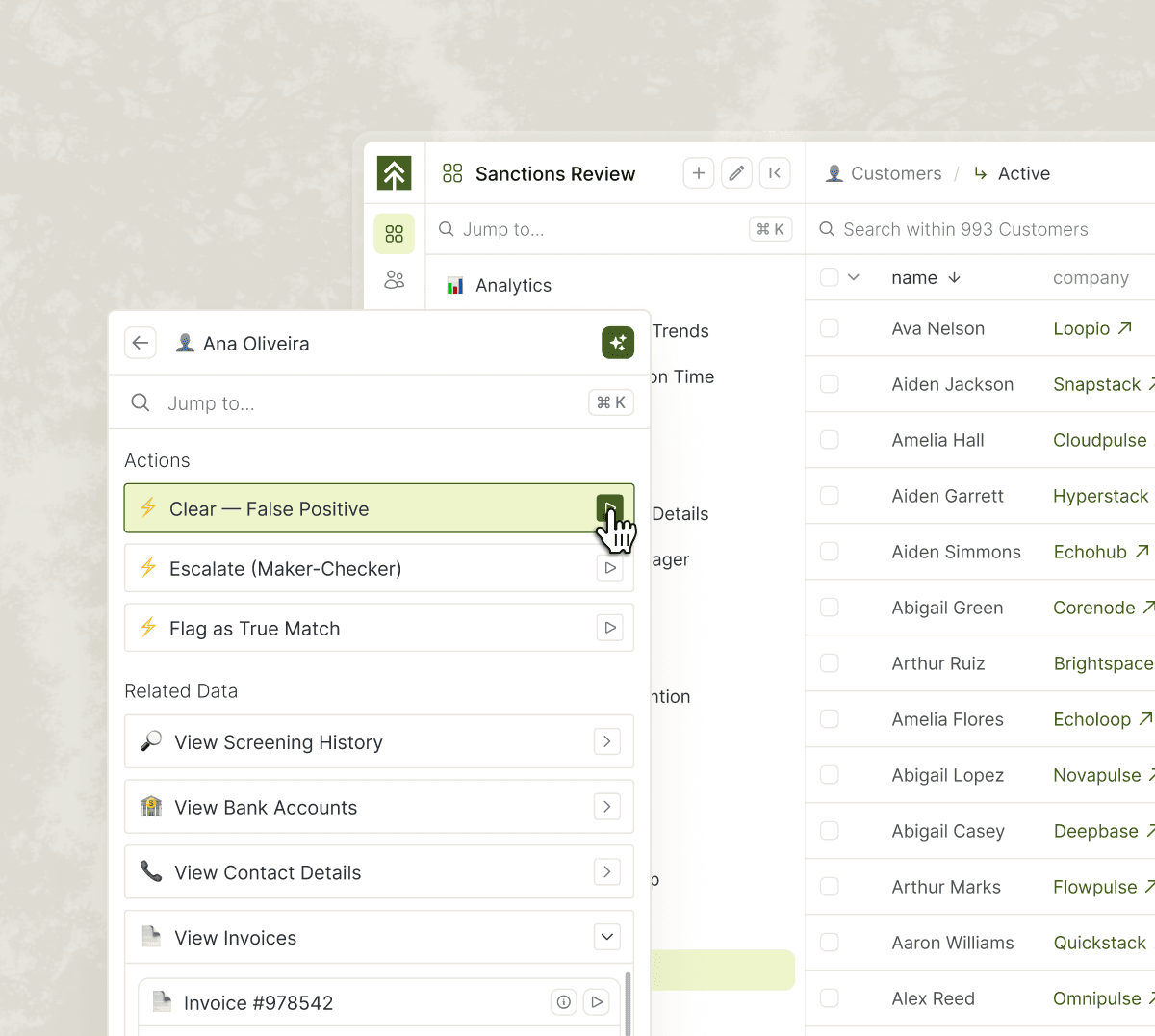
Your team and your AI agents resolve sanctions, PEP, and adverse-media hits in one inbox. Continuous re-screening against OFAC, EU, UN, and PEP lists, with audit logged.
" height="75px" id="C4fEeLmDf" transform="translate(0 0)" width="75px"/><path d="M 45 0 L 45 15 L 0 15 L 0 0 Z" fill="rgb(63, 91, 30)" height="15px" id="l1ApqBrJ1" transform="translate(30 15)" width="45px"/><path d="M 45 0 L 45 15 L 0 15 L 0 0 Z" fill="rgb(63, 91, 30)" height="15px" id="afBq3jDeI" transform="translate(30 45)" width="45px"/><path d="M 30 0 L 30 15 L 0 15 L 0 0 Z" fill="rgb(63, 91, 30)" height="15px" id="xTsh7vbCX" transform="translate(0 30)" width="30px"/></svg>)
Sanction screening as a workflow, on top of the providers you choose.
A workflow your AML team and your AI agents run on Forest, on top of ComplyAdvantage, Dow Jones, Refinitiv, or your existing list provider. Forest pulls customer changes from your data, sends them for screening, and records every match and decision
Payment flagged and held
Case opened, routed to compliance
Review context
Approve / fail, or open a request for info
Send RFI
Back to compliance, decide
Payment released
Forest is where your team and your AI agents work sanctions screening. List feeds stream in, hits queue up, homonyms resolve, decisions log. One workflow above any data provider you trust.
One hits inbox across providers
ComplyAdvantage, Refinitiv, Dow Jones, Moody's, LexisNexis hits aggregate into one queue on Forest. Your team stops bouncing between provider portals.
Continuous re-screening on list updates
When OFAC, EU, UN, or PEP lists update, Forest triggers re-screening on the affected records and surfaces new hits as cases. Sanctions stops being point-in-time.
Homonym resolution as a workflow
AI agents pre-process common false positives (homonyms, partial matches, low-confidence scores). Your reviewers focus on real risk, with the resolution path logged on each case.
Maker-checker on every decision
Forest applies maker-checker approval on cleared and confirmed hits. Reviewer, approver, timestamp, and reason are part of the case record.
Tipping-off controls built in
Forest enforces tipping-off controls at field-level. Customer-facing teams see only what regulation allows, while compliance retains the full case view.
Regulator-ready export
Every hit, every decision, every reviewer action logs to the case with the full causal chain. Filtered exports for ACPR or any supervisor run in one click.
Built for regulated fintechs at scale
" height="75px" id="zVbSHlMoa" width="75px"/><path d="M 0 0 L 15 0 L 15 45 L 0 45 Z" fill="rgb(63, 91, 30)" height="45px" id="CH_iVM7qH" width="15px"/><path d="M 60 0 L 60 30 L 0 30 L 0 0 Z" fill="rgb(63, 91, 30)" height="30px" id="ttSD1A5rV" transform="translate(15 45)" width="60px"/></svg>)
A single hits view per customer
Sanctions matches, PEP flags, adverse media, and historical decisions on the same record. The screening story lives in one place.
Governance for humans and AI agents
Maker-checker, tipping-off, RBAC, and audit apply to your reviewers and your AI agents the same way. One trail, one set of rules.
Sanctions data, fully connected
OFAC, EU, UN, HMT, PEP, and adverse-media feeds from ComplyAdvantage, Refinitiv, Dow Jones, Moody's ready to tap from your workflows.


Vendor agnostic


Frequently asked questions
You still have question ?
Book a conversation with a forest expert
What lists does Forest screen against?
Forest does not maintain its own list, your provider does. Forest plugs above ComplyAdvantage, Refinitiv, Dow Jones, Moody's, LexisNexis, and similar to cover OFAC, EU, UN, HMT, national PEP lists, and adverse media. Your workflow picks the provider and list per step.
How does Forest resolve homonym false positives?
Forest combines AI pre-processing (DOB match, address match, additional identifiers) with reviewer judgement. Your AI agents propose a homonym verdict, your reviewer approves or escalates. The reasoning chain logs to the case.
Can I keep my existing screening provider?
Yes. Forest is provider-agnostic. ComplyAdvantage, Refinitiv, Dow Jones, Moody's, LexisNexis, Sayari and others connect through MCP connectors or direct APIs. You can run two providers in parallel for coverage and consolidate the hits in one queue.
How does ongoing screening differ from initial screening?
Initial screening happens during onboarding (see [[identity-verification]]). Ongoing screening on Forest re-runs against the updated lists, on a schedule and on list-update triggers. Surfaced hits route to the AML workflow as cases.
How do AI agents help with sanctions screening?
Your AI agents pre-process hits, propose homonym resolutions, and draft reviewer notes. On Forest, every AI agent action runs with human-in-the-loop approval and logs to the case audit trail.
How does Forest log screening decisions for the regulator?
Every hit, every reviewer action, every maker-checker approval, every override is logged with the full causal chain inside your own infrastructure. Filtered exports run in one click.