" width="31.844343999969944px"><path d="M 0 31.84 L 0 0 L 31.84 0 L 31.84 31.84 Z" fill="transparent" height="31.8403px" id="bDMh1GdUQ" transform="translate(0.002 0)" width="31.8403px"/><path d="M 0 0 L 0 31.84 L 14.379 31.84 L 14.379 19.139 L 8.175 25.342 L 5.995 23.162 L 15.922 13.235 L 25.849 23.162 L 23.669 25.342 L 17.466 19.139 L 17.466 31.84 L 31.844 31.84 L 31.844 0 Z M 23.667 16.772 L 15.92 9.025 L 8.173 16.772 L 5.993 14.592 L 15.92 4.664 L 25.847 14.592 Z" fill="rgb(63, 91, 30)" height="31.84030625px" id="LkBC_qYlr" transform="translate(0 0.002)" width="31.844344px"/></g><path d="M 4.708 16.728 L 4.708 2.772 L 0 2.772 L 0 0 L 12.666 0 L 12.666 2.772 L 7.958 2.772 L 7.958 16.728 Z" fill="rgb(38, 45, 30)" height="16.72833px" id="gGM6jCh9B" transform="translate(117.426 7.593)" width="12.666000000000011px"/><path d="M 6.978 17.111 C 5.815 17.111 4.756 16.912 3.8 16.513 C 2.844 16.099 2.031 15.502 1.362 14.721 C 0.709 13.94 0.255 13 0 11.901 L 2.939 11.041 C 3.178 12.076 3.664 12.889 4.397 13.478 C 5.13 14.052 5.99 14.339 6.978 14.339 C 7.743 14.339 8.396 14.163 8.938 13.813 C 9.479 13.462 9.75 12.913 9.75 12.164 C 9.75 11.686 9.583 11.304 9.248 11.017 C 8.93 10.714 8.508 10.467 7.982 10.276 C 7.456 10.085 6.875 9.902 6.237 9.726 C 5.6 9.551 4.963 9.352 4.325 9.129 C 3.688 8.906 3.107 8.619 2.581 8.269 C 2.055 7.902 1.625 7.44 1.29 6.883 C 0.972 6.309 0.813 5.592 0.813 4.732 C 0.813 3.776 1.075 2.947 1.601 2.246 C 2.127 1.529 2.828 0.98 3.704 0.597 C 4.58 0.199 5.544 0 6.596 0 C 7.631 0 8.579 0.175 9.44 0.526 C 10.316 0.876 11.049 1.37 11.638 2.007 C 12.244 2.629 12.658 3.37 12.881 4.23 L 10.013 5.353 C 9.774 4.509 9.352 3.871 8.747 3.441 C 8.141 2.995 7.416 2.772 6.572 2.772 C 5.807 2.772 5.194 2.939 4.732 3.274 C 4.286 3.593 4.063 4.031 4.063 4.588 C 4.063 5.019 4.222 5.369 4.541 5.64 C 4.875 5.895 5.305 6.11 5.831 6.285 C 6.357 6.444 6.938 6.604 7.576 6.763 C 8.213 6.906 8.85 7.098 9.487 7.337 C 10.125 7.56 10.706 7.854 11.232 8.221 C 11.758 8.587 12.18 9.073 12.498 9.679 C 12.833 10.284 13 11.041 13 11.949 C 13 13.048 12.729 13.988 12.188 14.769 C 11.662 15.533 10.945 16.115 10.037 16.513 C 9.129 16.912 8.109 17.111 6.978 17.111 Z" fill="rgb(38, 45, 30)" height="17.11076px" id="W33rhMq3Y" transform="translate(102.662 7.402)" width="13px"/><path d="M 0 16.728 L 0 0 L 11.328 0 L 11.328 2.772 L 3.274 2.772 L 3.274 6.644 L 9.798 6.644 L 9.798 9.416 L 3.274 9.416 L 3.274 13.956 L 11.423 13.956 L 11.423 16.728 Z" fill="rgb(38, 45, 30)" height="16.72833px" id="LASbkhR29" transform="translate(89.162 7.593)" width="11.422699999999992px"/><path d="M 0 16.728 L 0 0 L 6.357 0 C 7.408 0 8.324 0.207 9.105 0.621 C 9.902 1.02 10.523 1.593 10.969 2.342 C 11.415 3.075 11.638 3.935 11.638 4.923 C 11.638 5.879 11.383 6.755 10.873 7.552 C 10.379 8.332 9.694 8.93 8.818 9.344 L 12.833 16.728 L 9.153 16.728 L 5.664 9.87 L 3.25 9.87 L 3.25 16.728 Z M 3.25 7.098 L 5.783 7.098 C 6.58 7.098 7.209 6.898 7.671 6.5 C 8.149 6.086 8.388 5.56 8.388 4.923 C 8.388 4.27 8.149 3.752 7.671 3.37 C 7.209 2.971 6.58 2.772 5.783 2.772 L 3.25 2.772 Z" fill="rgb(38, 45, 30)" height="16.72833px" id="DsldZOwJ8" transform="translate(73.861 7.593)" width="12.832999999999998px"/><path d="M 7.289 17.111 C 5.839 17.111 4.565 16.76 3.465 16.059 C 2.382 15.342 1.529 14.347 0.908 13.072 C 0.303 11.782 0 10.276 0 8.555 C 0 6.835 0.303 5.337 0.908 4.063 C 1.529 2.772 2.382 1.776 3.465 1.075 C 4.565 0.358 5.839 0 7.289 0 C 8.739 0 10.005 0.358 11.088 1.075 C 12.188 1.776 13.04 2.772 13.646 4.063 C 14.267 5.337 14.578 6.835 14.578 8.555 C 14.578 10.276 14.267 11.782 13.646 13.072 C 13.04 14.347 12.188 15.342 11.088 16.059 C 10.005 16.76 8.739 17.111 7.289 17.111 Z M 7.289 14.339 C 8.101 14.339 8.802 14.1 9.392 13.622 C 9.997 13.128 10.467 12.451 10.802 11.59 C 11.136 10.714 11.304 9.702 11.304 8.555 C 11.304 7.392 11.136 6.381 10.802 5.52 C 10.467 4.66 9.997 3.991 9.392 3.513 C 8.802 3.019 8.101 2.772 7.289 2.772 C 6.492 2.772 5.783 3.019 5.162 3.513 C 4.556 3.991 4.086 4.66 3.752 5.52 C 3.417 6.381 3.25 7.392 3.25 8.555 C 3.25 9.702 3.417 10.714 3.752 11.59 C 4.086 12.451 4.556 13.128 5.162 13.622 C 5.783 14.1 6.492 14.339 7.289 14.339 Z" fill="rgb(38, 45, 30)" height="17.11076px" id="ipX7BNsrY" transform="translate(56.609 7.402)" width="14.577600000000004px"/><path d="M 0 16.728 L 0 0 L 11.351 0 L 11.351 2.772 L 3.25 2.772 L 3.25 6.644 L 9.798 6.644 L 9.798 9.416 L 3.25 9.416 L 3.25 16.728 Z" fill="rgb(38, 45, 30)" height="16.72833px" id="T3zzexfqV" transform="translate(43.557 7.593)" width="11.351399999999998px"/></svg>)
AML & financial crime
Forest is the orchestration layer above your AML detection engines. Unify alerts, triage false positives, investigate cases, and prepare SAR filings in one workflow your team owns.
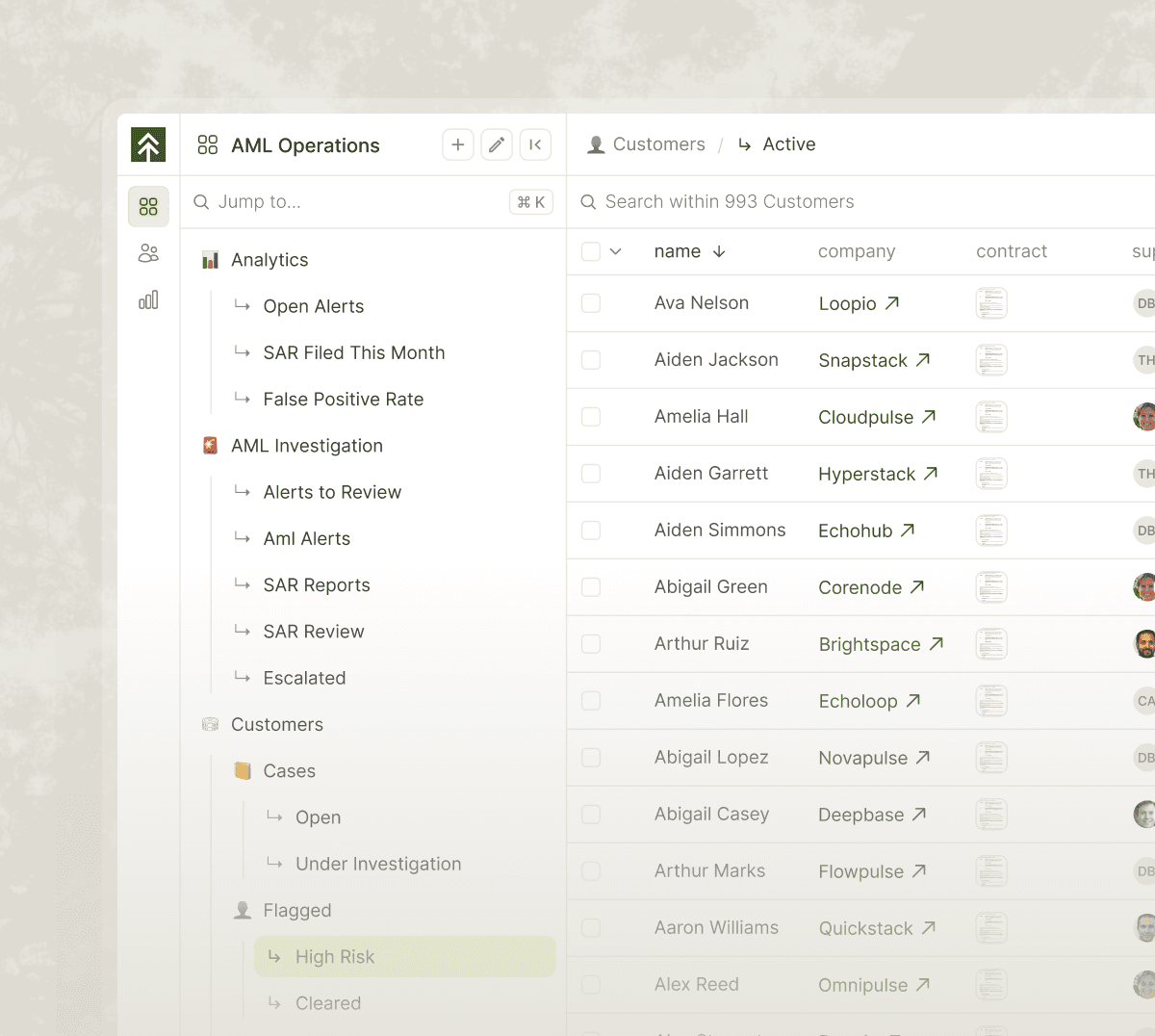
Forest is where your team and your AI agents own the AML lifecycle. Detection engines feed the inbox. Investigation builds the case. Reporting closes the loop. The trail your regulator expects is part of the work, not a quarterly export.
One inbox, every alert source
Transaction monitoring hits, sanctions matches, adverse media flags aggregate into one queue on Forest. Your team stops logging into five tools to see what needs attention.
AI agents triage the noise
Forest runs AI agents (Kolar and your own) that pre-process alerts and resolve homonym false positives. Analysts spend their time on real risk, with human-in-the-loop where regulation requires.
Investigation, end-to-end
Linked transactions, network view, EDD documentation, evidence collection on one case. Every step logged and timestamped for the regulator.
SAR filing as a workflow
Forest assembles the suspicious activity report from the case file and routes it to Tracfin via ERMES, with tipping-off controls regulation requires.
Human-in-the-loop on high-risk AI actions
AI proposes, your MLRO decides. On Forest, every AI agent action runs with human-in-the-loop approval, under the same RBAC and audit trail as your humans.
5-year evidence chain, retained
Every alert, decision, and SAR logged with the full causal chain inside your own infrastructure, for the 5-year retention regulators expect. One-click filtered export when ACPR asks.
Why Forest
" height="75px" id="zVbSHlMoa" width="75px"/><path d="M 0 0 L 15 0 L 15 45 L 0 45 Z" fill="rgb(63, 91, 30)" height="45px" id="CH_iVM7qH" width="15px"/><path d="M 60 0 L 60 30 L 0 30 L 0 0 Z" fill="rgb(63, 91, 30)" height="30px" id="ttSD1A5rV" transform="translate(15 45)" width="60px"/></svg>)
Every alert, one queue
Forest brings transaction monitoring, sanctions, and adverse-media alerts into one inbox. Your team stops switching between detection tools, and nothing falls through the cracks.
Analysts work real risk, not noise
Forest runs AI pre-processing to clear homonym false positives before they reach an analyst, under human-in-the-loop governance. Your team spends its hours on real risk.
Every decision stands up to the ACPR
Every alert, decision, and SAR logs with the full causal chain inside your own infrastructure, retained for 5 years. The audit is a filtered export, not a fire drill.


Vendor agnostic





Frequently asked questions
You still have question ?
Book a conversation with a forest expert
What is an AML workflow on Forest?
An AML workflow is the end-to-end process your team runs from detection to filing: alert intake, triage, case investigation, EDD, MLRO decision, SAR preparation, regulatory submission, retention. On Forest, every step is a configurable task and every action logs to the case.
How is Forest different from ComplyAdvantage, Sardine, or Hawk AI?
Forest does not detect, your engines do. Forest is the operational layer above them: alert aggregation, AI triage, case investigation, SAR filing, audit trail. Most customers keep their detection engines and use Forest to orchestrate the work that follows.
How do I file a SAR through Forest?
Your MLRO approves the case in Forest. Forest assembles the suspicious activity report from the case file, routes it to Tracfin through ERMES, and applies the tipping-off controls regulation requires. The full filing chain is logged for the 5-year retention regulators expect.
How does Forest support AI governance in AML?
AI proposes, your MLRO decides. On Forest, AI agent actions run under human-in-the-loop approval where your policies require it. Every reasoning step, every decision, every override is logged in the same audit trail as your humans. Forest gives you the evidence layer; your legal counsel maps that evidence to the obligations your jurisdiction puts on AI use in AML.
How does Forest meet AMLR and DORA retention requirements?
Forest logs every alert, decision, and SAR with the full causal chain inside your own infrastructure for the 5-year retention regulators expect. DORA operational-resilience evidence comes from the same trail. Filtered exports run in one click.
How do you ensure customer data never leaves our environment?
The Forest backend runs inside your infrastructure, alongside your databases. Customer and transaction data travels to a detection engine only at the point where its service is called, and the response logs back to the case. Data stays in your systems of record.
Can I run Forest above multiple TM engines at once?
Yes. Forest aggregates alerts across engines (Sardine for one rail, Hawk AI for another, an in-house model for a third) into one queue, with the source tagged on each case. Add or swap an engine as a configuration change.